
Choosing not to drink alcohol is a personal decision, and for many people, it’s a private one too. Whether someone stops for a month or for good, telling coworkers, friends, or a date may mean fielding questions they’d rather avoid.
We surveyed 1,004 Americans, including 242 who have stopped drinking for at least a month, to learn who sober Americans tell, how often they disguise not drinking, and how others react. We also asked everyone how they view people who don’t drink. The results reveal a gap between the judgment sober Americans brace for and what most people say they actually think.
Key Takeaways
- 58% of sober Americans keep their decision not to drink private from some people in their lives, and 13% keep it from everyone.
- Nearly 2 in 5 sober Americans keep their sobriety hidden at work.
- Nearly 1 in 3 sober Americans have pretended to drink to fit in: 30% have disguised their sobriety in social settings, including holding nonalcoholic drinks that appear to contain alcohol.
- 52% of sober Americans have faced questioning, pressure, or teasing about not drinking.
- 1 in 5 Americans (20%) would assume a coworker or date who doesn’t drink is in recovery or has a history of alcohol addiction.
Who Sober Americans Tell and Who They Don’t
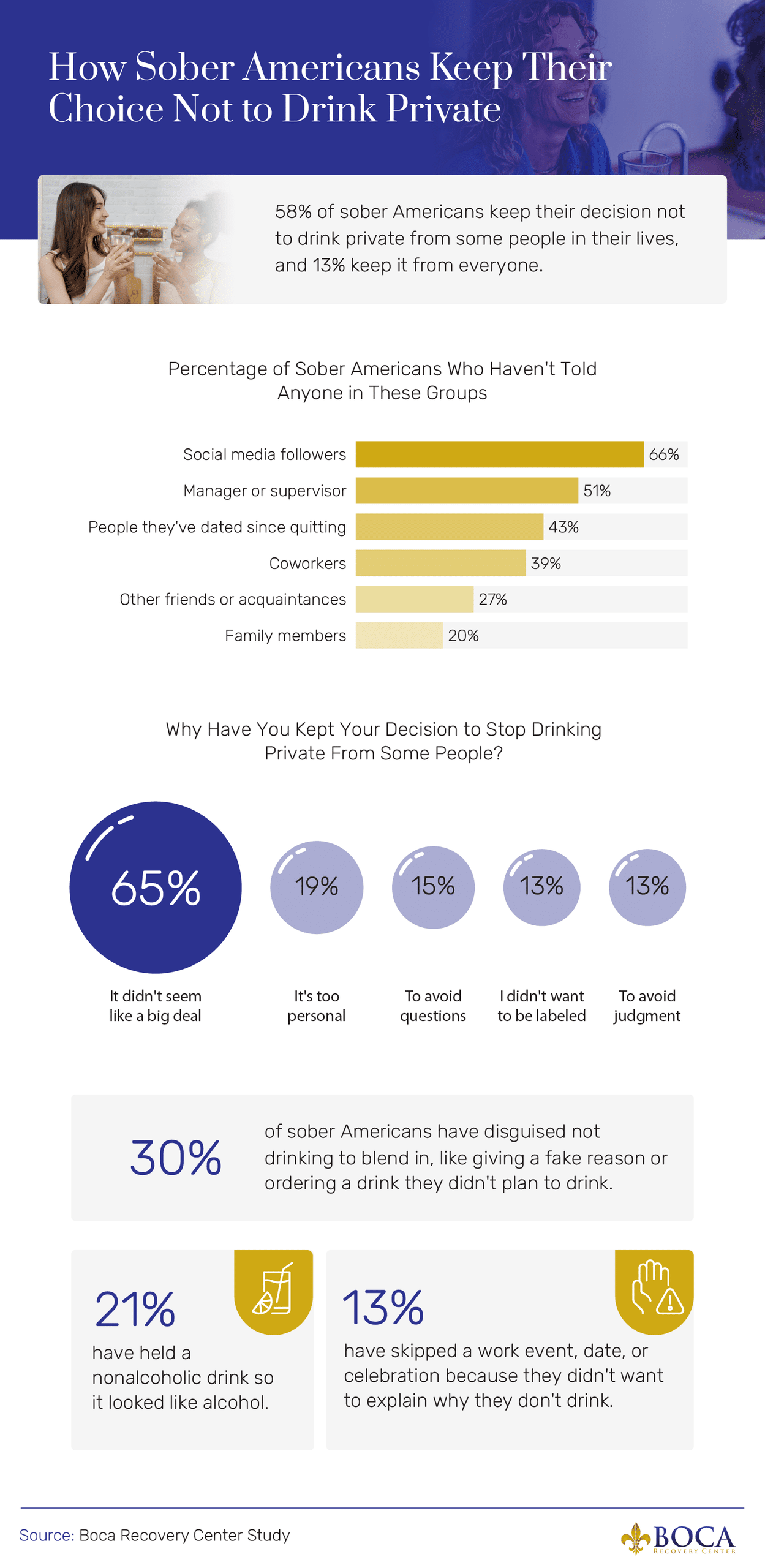
- 58% of sober Americans keep their decision not to drink private from some people in their lives, and 13% keep it from everyone. Share of each generation that hasn’t told anyone they stopped drinking:
- Gen X: 20%
- Millennials: 12%
- Baby boomers: 10%
- Gen Z: 5%
- 39% of sober Americans with coworkers haven’t told any of them that they don’t drink.
- 30% of sober Americans have disguised not drinking to blend in socially, like holding a nonalcoholic drink so it looked like alcohol.
- 16% of sober Americans have given a fake reason for not drinking, like saying they weren’t feeling well or that they were driving.
- Fake reasons sober Americans gave for not drinking (among those who have given one):
- I wasn’t feeling well: 49%
- I was driving: 36%
- I had an early morning: 26%
- I was taking medication: 23%
- I was on a diet or health plan: 18%
- I’d already had enough to drink: 13%
- 13% of sober Americans have skipped a work event, date, or celebration because they didn’t want to explain why they don’t drink.
- Millennials: 16%
- Gen Z: 15%
- Gen X: 11%
- Baby boomers: 6%
- Half of sober Americans (50%) stopped drinking for their physical or mental health. Only 10% stopped to recover from alcohol use. Stopped for physical or mental health, by generation:
- Gen X: 54%
- Millennials: 52%
- Baby boomers: 45%
- Gen Z: 44%
How Others React When Someone Doesn’t Drink
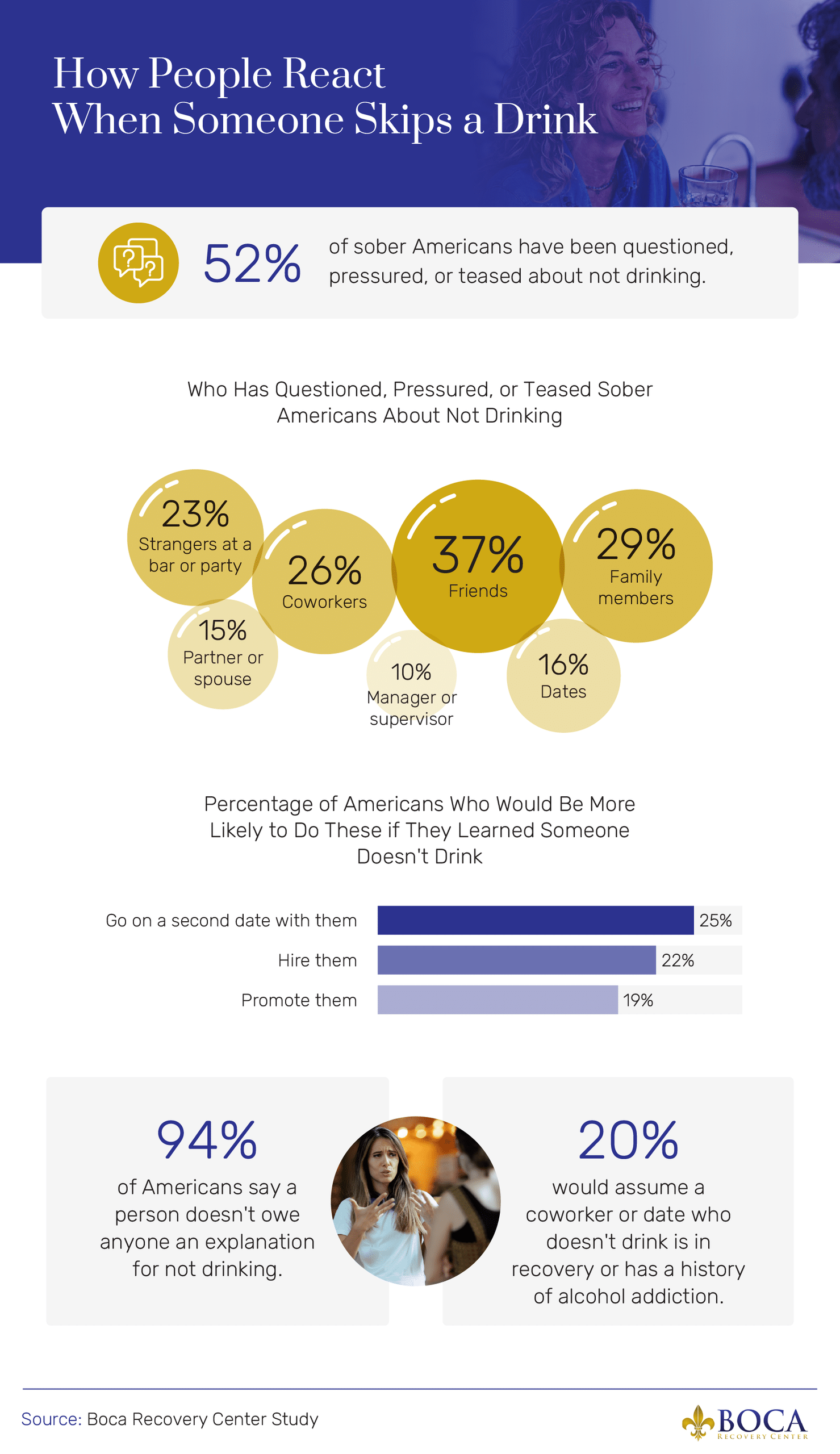
- 52% of sober Americans have faced questioning, pressure, or teasing about not drinking.
- 69% of sober Gen Zers have been questioned, pressured, or teased about not drinking, compared to 49% of other sober Americans.
- 93% of Americans say they wouldn’t think less of a coworker who doesn’t drink at a work event.
- 1 in 5 Americans (20%) would assume a coworker or date who doesn’t drink is in recovery or has a history of alcohol addiction.
- 1 in 4 Americans (25%) have tried an alcohol-free or reduced-drinking challenge. More have tried a personal challenge, such as a 30-day break (14%), than Dry January (8%). Did at least one challenge, by generation:
- Millennials: 29%
- Gen Z: 26%
- Gen X: 23%
- Baby boomers: 10%
- 40% of Americans who have done an alcohol-free challenge say it made them consider stopping drinking, but they haven’t stopped long-term.
Protecting Your Sobriety on Your Own Terms
Our findings show that many sober Americans go out of their way to avoid explaining why they don’t drink, even though most people say they wouldn’t judge them for it. Whether you stopped for your health, your goals, or your recovery, you don’t owe anyone an explanation. A few simple strategies can make social situations easier:
- Keep a short answer ready: A simple, honest line like “I’m not drinking tonight” is usually enough, and it saves you from inventing a reason on the spot.
- Choose your own drink early: Ordering a soda, mocktail, or sparkling water as soon as you arrive can head off offers before they start.
- Tell one trusted person: Sharing your decision with a friend or coworker you trust gives you an ally who can help redirect the conversation.
- Give yourself permission to leave: If an event starts to feel like too much pressure, it’s okay to step outside or head home early.
For some people, a break from alcohol reveals something bigger. Four in 10 Americans who tried an alcohol-free challenge said it made them consider quitting, even though they haven’t stopped long-term. If cutting back felt harder than you expected, or you noticed signs of a drinking problem along the way, that’s worth paying attention to.
Stopping suddenly after long-term heavy drinking can cause dangerous withdrawal symptoms, so medical support matters. Our team can help you find alcohol detox near you and guide you through alcohol rehab options that fit your needs. You can also explore research-backed information from the National Institute on Alcohol Abuse and Alcoholism. Recovery is nothing to hide, but how and when you share it is always your choice.
Methodology
We surveyed 1,004 Americans about their relationship with alcohol using Connect by CloudResearch from October 7 to October 8, 2026, including 242 who had stopped drinking for at least one month; 57% of respondents identified as women, 41% as men, and 1% as non-binary or another gender. We asked people who had stopped drinking whom they had told, whether they had ever disguised their not drinking, and how others reacted. We asked all respondents how they view people who don’t drink, including whether someone owes an explanation and what they would assume about a coworker or date who doesn’t drink. The generational breakdown was 44% millennials, 27% Gen X, 21% Gen Z, and 8% baby boomers. Percentages may not total 100% due to rounding.
About Boca Recovery Center
At Boca Recovery Center, we combine advanced addiction treatment with the amenities needed to ensure a secure, comfortable, and lasting recovery. We offer medical detox and residential treatment, along with medication-assisted treatment, and connect clients with trusted outpatient partners for step-down care. We address both substance use and co-occurring mental health disorders with evidence-based therapies guided by a highly experienced staff.
Fair Use Statement
Feel free to share these findings for noncommercial purposes. We just ask that you credit Boca Recovery Center and link back to this page so readers can access the full study and methodology.